TechDocs CLI
Utility command line interface for managing TechDocs sites in Backstage.
https://backstage.io/docs/features/techdocs/
Features
- Supports local development/preview of a TechDocs site in a Backstage app.
- Supports generation and publishing of a documentation site in a CI/CD workflow.
- Supports every documentation engine TechDocs ships with: MkDocs (the default) and Zensical.
techdocs-cli --help
Usage: techdocs-cli [options] [command]

Options:
  -V, --version             output the version number
  -h, --help                display help for command

Commands:
  generate|build [options]  Generate a TechDocs documentation site with the
                            selected engine (MkDocs by default).
  migrate [options]         Migrate objects with case-sensitive entity triplets
                            to lower-case versions.
  publish [options]         Publish generated TechDocs site to an external
                            storage AWS S3, Google GCS, etc.
  serve:raw [options]       Serve a documentation project locally using the
                            configured engine.
  serve:mkdocs [options]    [Deprecated: use serve:raw] Serve a documentation
                            project locally.
  serve [options]           Serve a documentation project locally in a Backstage
                            app-like environment
  help [command]            display help for command
Installation
You can always use npx to run the latest version
of techdocs-cli -
npx @techdocs/cli [command]
Or you can install it using npm -
npm install -g @techdocs/cli
techdocs-cli [command]
Usage
Preview TechDocs site locally in a Backstage like environment
techdocs-cli serve
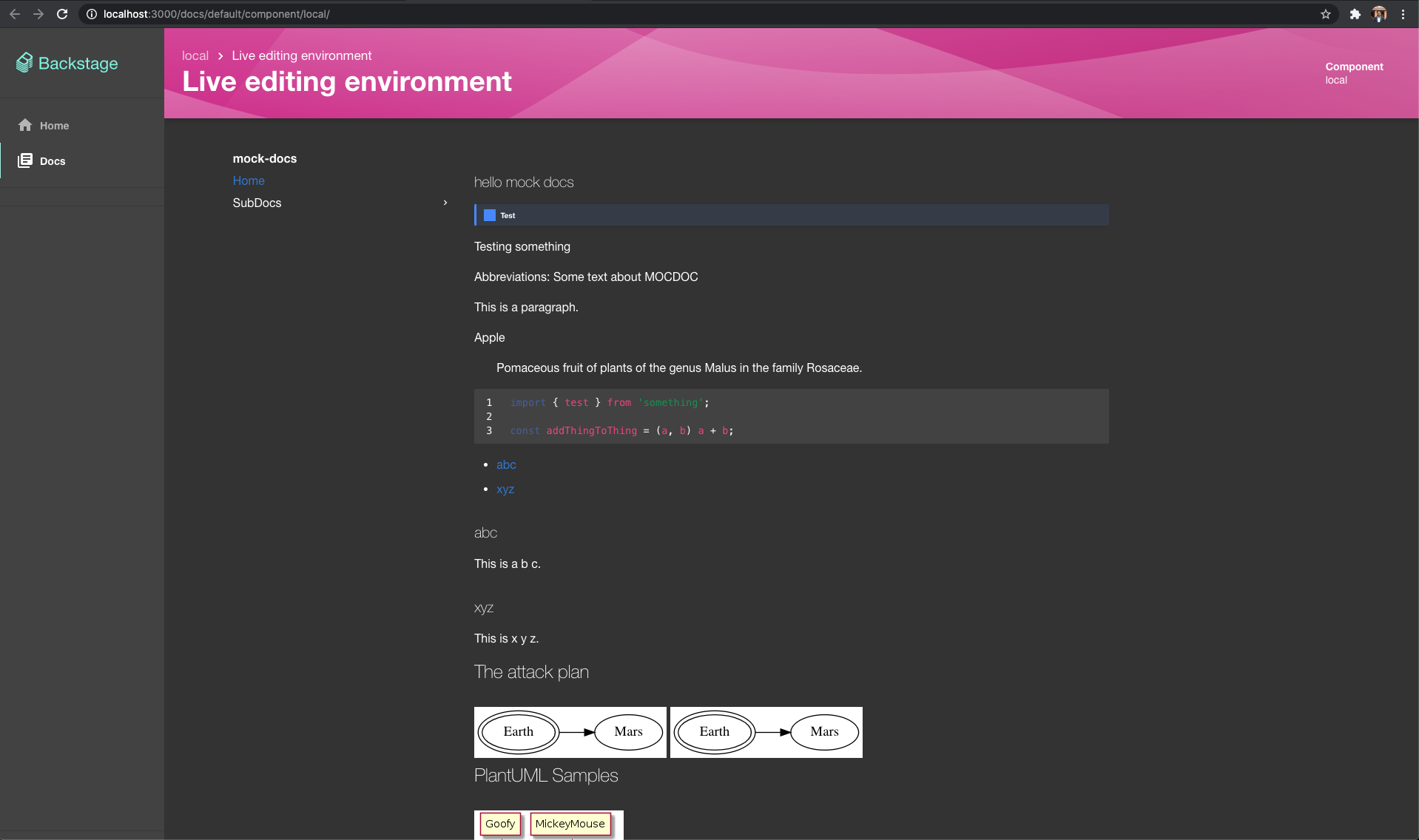
By default, Docker and
techdocs-container is used to
make sure all the dependencies are installed. However, Docker can be disabled
with --no-docker flag.
Note that the serve command does not pull the Docker image and keeps using the
one available locally. If serving misbehaves, for example changes to
documentation files are no longer detected, update the image with
docker pull spotify/techdocs.
The command starts two local servers - the documentation engine's preview
server on port 8000 (change it with --engine-port) and a Backstage app server
on port 3000. The Backstage app has a custom TechDocs API implementation, which
uses the engine's preview server as a proxy to fetch the generated
documentation files and assets.
The engine is --engine if passed, otherwise the
backstage.io/techdocs-engine annotation in the catalog-info.yaml in the
current directory, otherwise mkdocs. The default Docker image depends on the
engine: spotify/techdocs for MkDocs and ghcr.io/backstage/techdocs-zensical
for Zensical. See Zensical Engine for running Zensical
without Docker.
Backstage instances might differ from the provided preview app in appearance and
behavior. To preview documentation with a different app, use
--preview-app-bundle-path with a path to the bundle of the app to use instead.
Typically, a dist or build directory.
NOTE: When using a custom Docker image, make sure its entry point is the
engine's command (ENTRYPOINT ["mkdocs"] or ENTRYPOINT ["zensical"]), or
override it with --docker-entrypoint.
Command reference:
Usage: techdocs-cli serve [options]

Serve a documentation project locally in a Backstage app-like environment

Options:
  -i, --docker-image <DOCKER_IMAGE>           Docker image to use. Defaults to the selected engine's image.
  --docker-entrypoint <DOCKER_ENTRYPOINT>     Override the image entrypoint
  --docker-option <DOCKER_OPTION...>          Extra options to pass to the docker run command, e.g. "--add-host=internal.host:192.168.11.12" (can be added multiple times).
  --no-docker                                 Do not use Docker, run the engine in the current user environment.
  --site-name                                 Name for site when using the default config
  --engine-port <PORT>                        Port for the documentation engine server (MkDocs, Zensical, etc.) to listen on. Defaults to 8000. The Backstage preview app is served on --preview-app-port.
  --mkdocs-port <PORT>                        [Deprecated: use --engine-port] Port for MkDocs server to use
  -v, --verbose                               Enable verbose output. (default: false)
  --preview-app-bundle-path <PATH_TO_BUNDLE>  Preview documentation using another web app
  --preview-app-port <PORT>                   Port for the preview app to be served on (default: "3000")
  -c, --config-file-name <FILENAME>           Config file name for the documentation engine (e.g. mkdocs.yml). Overrides automatic detection.
  --mkdocs-config-file-name <FILENAME>        [Deprecated: use --config-file-name] Mkdocs config file name
  --parameter-clean                           Pass "--clean" to the documentation engine server. Clears the build cache before serving. (default: false)
  --mkdocs-parameter-clean                    [Deprecated: use --parameter-clean] Pass "--clean" parameter to mkdocs server (default: false)
  --parameter-dirtyreload                     Pass "--dirtyreload" to the documentation engine server. Only rebuilds changed files on reload (MkDocs only; ignored by other engines). (default: false)
  --mkdocs-parameter-dirtyreload              [Deprecated: use --parameter-dirtyreload] Pass "--dirtyreload" parameter to mkdocs server (default: false)
  --parameter-strict                          Pass "--strict" to the documentation engine server. Treats warnings as errors during build. (default: false)
  --mkdocs-parameter-strict                   [Deprecated: use --parameter-strict] Pass "--strict" parameter to mkdocs server (default: false)
  --engine <ENGINE>                           Documentation engine to use. Overrides the backstage.io/techdocs-engine annotation in catalog-info.yaml; defaults to mkdocs.
  -h, --help                                  display help for command
The --mkdocs-* options are deprecated, see Deprecated options.
Serve with the engine's own preview server
techdocs-cli serve:raw
Runs the engine's own serve command (for example mkdocs serve) without the
Backstage preview app. It picks the engine the same way as serve.
serve:mkdocs is a deprecated alias for this command.
Command reference:
Usage: techdocs-cli serve:raw [options]

Serve a documentation project locally using the configured engine.

Options:
  -i, --docker-image <DOCKER_IMAGE>        Docker image to use. Defaults to the selected engine's image.
  --docker-entrypoint <DOCKER_ENTRYPOINT>  Override the image entrypoint
  --docker-option <DOCKER_OPTION...>       Extra options to pass to the docker run command, e.g. "--add-host=internal.host:192.168.11.12" (can be added multiple times).
  --no-docker                              Do not use Docker, run the engine serve command in the current user environment.
  --site-name                              Name for site when using the default config
  -p, --port <PORT>                        Port to serve documentation locally (default: "8000")
  -v, --verbose                            Enable verbose output. (default: false)
  --engine <ENGINE>                        Documentation engine to use. Overrides the backstage.io/techdocs-engine annotation in catalog-info.yaml; defaults to mkdocs.
  -h, --help                               display help for command
Generate TechDocs site from a documentation project
techdocs-cli generate
Alias: techdocs-cli build
The generate command uses the
@backstage/plugin-techdocs-node
package from Backstage for consistency. A Backstage app can also generate and
publish TechDocs sites if techdocs.builder is set to 'local' in
app-config.yaml. See
configuration reference.
By default, this command uses Docker and
techdocs-container to make
sure all the dependencies are installed. But it can be disabled using
--no-docker flag.
The engine is chosen the same way as for serve: --engine, then the
backstage.io/techdocs-engine annotation in catalog-info.yaml, then
mkdocs. The chosen engine is recorded in techdocs_metadata.json, and
--engine takes precedence over the annotation.
Command reference:
techdocs-cli generate --help
Usage: techdocs-cli generate|build [options]

Generate a TechDocs documentation site with the selected engine (MkDocs by
default).

Options:
  --source-dir <PATH>                                   Source directory containing mkdocs.yml and docs/ directory. (default: ".")
  --output-dir <PATH>                                   Output directory containing generated TechDocs site. (default: "./site/")
  --docker-image <DOCKER_IMAGE>                         Docker image to use. Defaults to the selected engine's image.
  --no-pull                                             Do not pull the latest docker image
  --no-docker                                           Do not use Docker, run the engine and its plugins in the current user environment.
  --techdocs-ref <HOST_TYPE:URL>                        The repository hosting documentation source files e.g. url:https://ghe.mycompany.net.com/org/repo.
  This value is same as the backstage.io/techdocs-ref annotation of the corresponding Backstage entity.
  It is completely fine to skip this as it is only being used to set repo_url in mkdocs.yml if not found.

  --etag <ETAG>                                         A unique identifier for the prepared tree e.g. commit SHA. If provided it will be stored in techdocs_metadata.json. If omitted, a sha256 content hash of the generated site output is computed automatically.
  --site-name                                           Name for site when using the default config
  -v, --verbose                                         Enable verbose output. (default: false)
  --omitTechdocsCoreMkdocsPlugin                        Don't patch MkDocs file automatically with techdocs-core plugin. (default: false)
  --legacyCopyReadmeMdToIndexMd                         Attempt to ensure an index.md exists falling back to using <docs-dir>/README.md or README.md in case a default <docs-dir>/index.md is not provided. (default: false)
  --disableExternalFonts                                Disable external font downloads by default by setting theme.font: false in mkdocs.yml when not already configured. Useful for air-gapped environments where Google fonts cannot be accessed. (default: false)
  --defaultPlugin [defaultPlugins...]                   Plugins which should be added automatically to the mkdocs.yaml file (default: [])
  --dangerouslyAllowAdditionalKeys [additionalKeys...]  Top-level mkdocs.yml keys to allow beyond the built-in supported set, without failing or stripping them. Same as the techdocs.generator.mkdocs.dangerouslyAllowAdditionalKeys backend config option, which techdocs-cli generate does not currently read from a config file. (default: [])
  --runAsDefaultUser                                    Bypass setting the container user as the same user and group id as host for Linux and MacOS (default: false)
  --engine <ENGINE>                                     Documentation engine to use. Overrides the backstage.io/techdocs-engine annotation in catalog-info.yaml; defaults to mkdocs.
  -h, --help                                            display help for command
Deprecated options
These still work but print a warning. If both the old and new option are given, the new one is used and the warning says the old one is ignored.
| Deprecated | Use instead |
|---|---|
serve:mkdocs | serve:raw |
serve --mkdocs-port | --engine-port |
serve --mkdocs-config-file-name | --config-file-name |
serve --mkdocs-parameter-clean | --parameter-clean |
serve --mkdocs-parameter-dirtyreload | --parameter-dirtyreload |
serve --mkdocs-parameter-strict | --parameter-strict |
Publish generated TechDocs sites
techdocs-cli publish --publisher-type <awsS3|googleGcs|azureBlobStorage> --storage-name <bucket/container name> --entity <namespace/kind/name>
After generating a TechDocs site using techdocs-cli generate, use the publish
command to upload the static generated files on a cloud storage (AWS/GCS) bucket
or (Azure) container which your Backstage app can read from.
The value for --entity must be the Backstage entity which the generated
TechDocs site belongs to. You can find the values in your Entity's
catalog-info.yaml file. If namespace is missing in the catalog-info.yaml,
use default. The directory structure used in the storage bucket is
namespace/kind/name/<files>.
Note that the values are case-sensitive. An example for --entity is
default/Component/<entityName>.
Command reference:
Usage: techdocs-cli publish [options]

Publish generated TechDocs site to an external storage AWS S3, Google GCS, etc.

Options:
  --publisher-type <TYPE>                                       (Required always) awsS3 | googleGcs | azureBlobStorage | openStackSwift - same as techdocs.publisher.type in Backstage app-config.yaml
  --storage-name <BUCKET/CONTAINER NAME>                        (Required always) In case of AWS/GCS, use the bucket name. In case of Azure, use container name. Same as
                                                                techdocs.publisher.[TYPE].bucketName
  --entity <NAMESPACE/KIND/NAME>                                (Required always) Entity uid separated by / in namespace/kind/name order (case-sensitive). Example: default/Component/myEntity
  --legacyUseCaseSensitiveTripletPaths                          Publishes objects with cased entity triplet prefix when set (e.g. namespace/Kind/name). Only use if your TechDocs backend is configured
                                                                the same way. (default: false)
  --azureAccountName <AZURE ACCOUNT NAME>                       (Required for Azure) specify when --publisher-type azureBlobStorage
  --azureAccountKey <AZURE ACCOUNT KEY>                         Azure Storage Account key to use for authentication. If not specified, you must set AZURE_TENANT_ID, AZURE_CLIENT_ID &
                                                                AZURE_CLIENT_SECRET as environment variables.
  --awsRoleArn <AWS ROLE ARN>                                   Optional AWS ARN of role to be assumed.
  --awsEndpoint <AWS ENDPOINT>                                  Optional AWS endpoint to send requests to.
  --awsProxy <HTTPS Proxy>                                      Optional Proxy to use for AWS requests.
  --awsS3sse <AWS SSE>                                          Optional AWS S3 Server Side Encryption.
  --awsS3ForcePathStyle                                         Optional AWS S3 option to force path style.
  --awsBucketRootPath <AWS BUCKET ROOT PATH>                    Optional sub-directory to store files in Amazon S3
  --awsMaxAttempts <AWS MAX ATTEMPTS>                           Optional maximum number of retries for AWS S3 operations. If not specified, default value of 3 is used.
  --osCredentialId <OPENSTACK SWIFT APPLICATION CREDENTIAL ID>  (Required for OpenStack) specify when --publisher-type openStackSwift
  --osSecret <OPENSTACK SWIFT APPLICATION CREDENTIAL SECRET>    (Required for OpenStack) specify when --publisher-type openStackSwift
  --osAuthUrl <OPENSTACK SWIFT AUTHURL>                         (Required for OpenStack) specify when --publisher-type openStackSwift
  --osSwiftUrl <OPENSTACK SWIFT SWIFTURL>                       (Required for OpenStack) specify when --publisher-type openStackSwift
  --gcsBucketRootPath <GCS BUCKET ROOT PATH>                    Optional sub-directory to store files in Google cloud storage
  --directory <PATH>                                            Path of the directory containing generated files to publish (default: "./site/")
  --skip-if-unchanged                                           Skip publishing if the local etag in techdocs_metadata.json matches the remote etag.
                                                                The generate step computes a generated site content hash automatically unless --etag is overridden. (default: false)
  -h, --help                                                    display help for command
Publishing from behind a proxy
Set NODE_USE_ENV_PROXY=1 along with HTTP_PROXY/HTTPS_PROXY/NO_PROXY to route TechDocs publishing through a proxy. See the corporate proxy guide for details.
Migrate content for case-insensitive access
Prior to the beta version of TechDocs (v[0.11.0]), TechDocs were stored in
object storage using a case-sensitive entity triplet (e.g.
default/API/name/index.html). This resulted in a limitation where that exact
case was required in the Backstage URL in order to read/render TechDocs content.
As of v[0.11.0] of the TechDocs plugin, any case is allowed in the URL (e.g.
default/api/name), matching the behavior of the Catalog plugin.
Backstage instances created with TechDocs v[0.11.0] or later do not need this
command. However, when upgrading to this version from an older version of
TechDocs, the migrate command can be used prior to deployment to ensure docs
remain accessible without having to rebuild all docs.
Prior to upgrading to v[0.11.0] or greater, run this command to copy all
assets to their lower-case triplet equivalents like this:
techdocs-cli migrate --publisher-type <awsS3|googleGcs|azureBlobStorage> --storage-name <bucket/container name> --verbose
Once migrated and the upgraded version of the Backstage plugin has been
deployed, you can clean up the legacy, case-sensitive triplet files by
re-running the command with the --removeOriginal flag passed, which moves
(rather than copies) the files. Note: this deletes files and is therefore a
destructive operation that should performed with caution.
techdocs-cli migrate --publisher-type <awsS3|googleGcs|azureBlobStorage> --storage-name <bucket/container name> --removeOriginal --verbose
Afterward, update your TechDocs CLI to v[0.7.0] to ensure further publishing
happens using a lower-case entity triplet.
Note: arguments for this command largely match those of the publish command,
depending on your chosen storage provider. Run techdocs-cli migrate --help for
details.
Authentication
You need to make sure that your environment is able to authenticate with the
target cloud provider. techdocs-cli uses the official Node.js clients provided
by AWS (v3), Google Cloud and Azure. You can authenticate using environment
variables and/or by other means (~/.aws/credentials, ~/.config/gcloud etc.)
Refer to the Authentication section of the following documentation depending upon your cloud storage provider -
Development
You are welcome to contribute to TechDocs CLI to improve it and support new features! See the project README for more information.